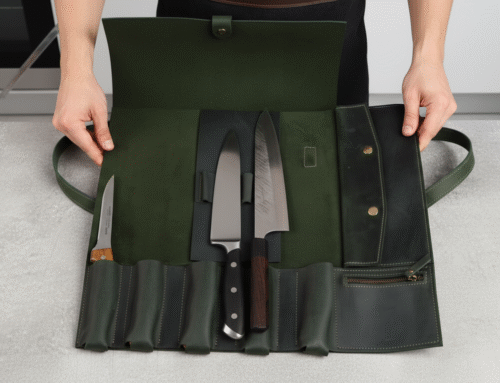
Most knife guides begin by getting lost in a jungle of shapes. You are immediately bombarded with exotic names: Santoku, Gyuto, Nakiri… It’s akin to choosing a car based solely on its paint job, without considering whether you’ll be navigating narrow old-town streets or trudging through muddy forest tracks.
A Japanese knife is not just a tool. It is a relationship. And like any long-term relationship, it requires compatibility. So, in this story, we are going to flip the script. We won’t start at the display case; we will start with You.
Before diving into the world of blades, transport yourself mentally to your own kitchen, standing before the sink and the cutting board. That is where the answer lies.
The Steel Test
This is a critical moment that many overlook. Japanese metallurgy offers two very different paths, and your choice depends not on what looks “better” on paper, but on your cooking and dishwashing habits.
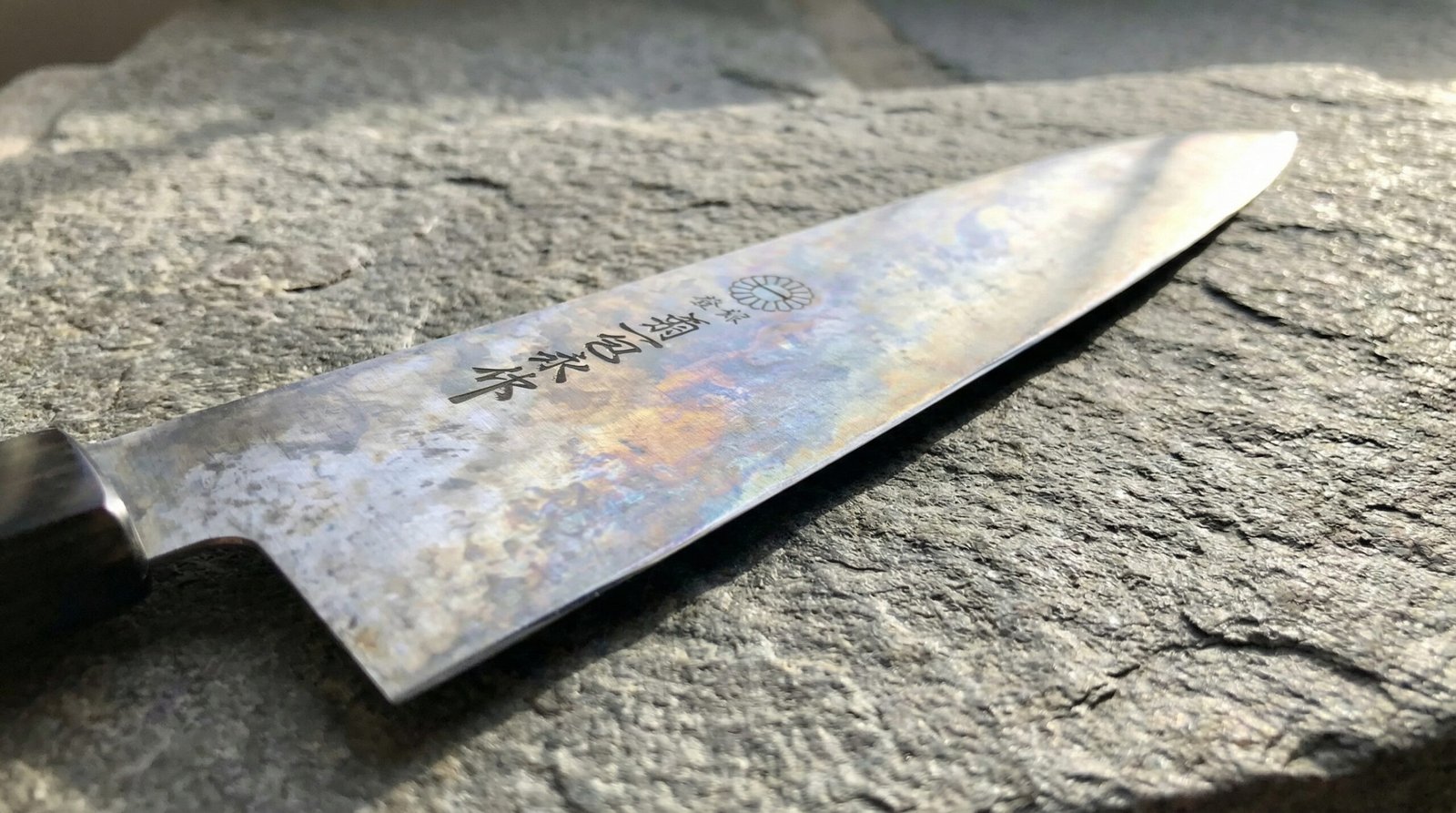 The first path leads to “Living Steel.” This is traditional Japanese high-carbon steel, such as Aogami (青紙 Blue Paper) or Shirogami (白紙 White Paper). Imagine a surgeon’s scalpel: these knives achieve a sharpness that seems almost supernatural. The cut feels like passing through melting butter, and sharpening them is a surprisingly easy and pleasurable process.
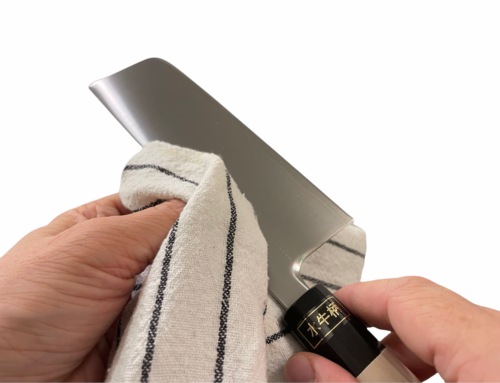
However, this pleasure comes at the cost of iron discipline. If you leave such a knife wet on the counter for even thirty minutes, it will begin to rust. If you slice a lemon and don’t wipe the blade immediately, the acid will leave its mark. These knives are for perfectionists who see patina (the natural protective layer that forms over time) not as dirt, but as part of the knife’s history, sometimes even cultivating it intentionally with various compounds. Learn more about patina here.
If reading those lines caused you even the slightest anxiety or doubt—stop.
The second path is for you: the Stainless Steel. This is a triumph of modern technology. Steels like SG2/R2 (powdered steel) or VG10 are tempered to extreme hardness, holding an edge for a long time, yet they are forgiving. These are knives that pardon your mistakes. You can leave the knife on the board and go have dinner with your family. No rust, no stress. If you have doubts about your habits—or those of your household members—this is the safest start, and one that certainly won’t disappoint.
The Philosophy of Shape
 The Japanese have a wonderful proverb: “Taru wo shiru” (足るを知る), which means “Know what is enough.” Contrary to what big box stores tell you, you definitely do not need a seven-piece block set. You need a solution.
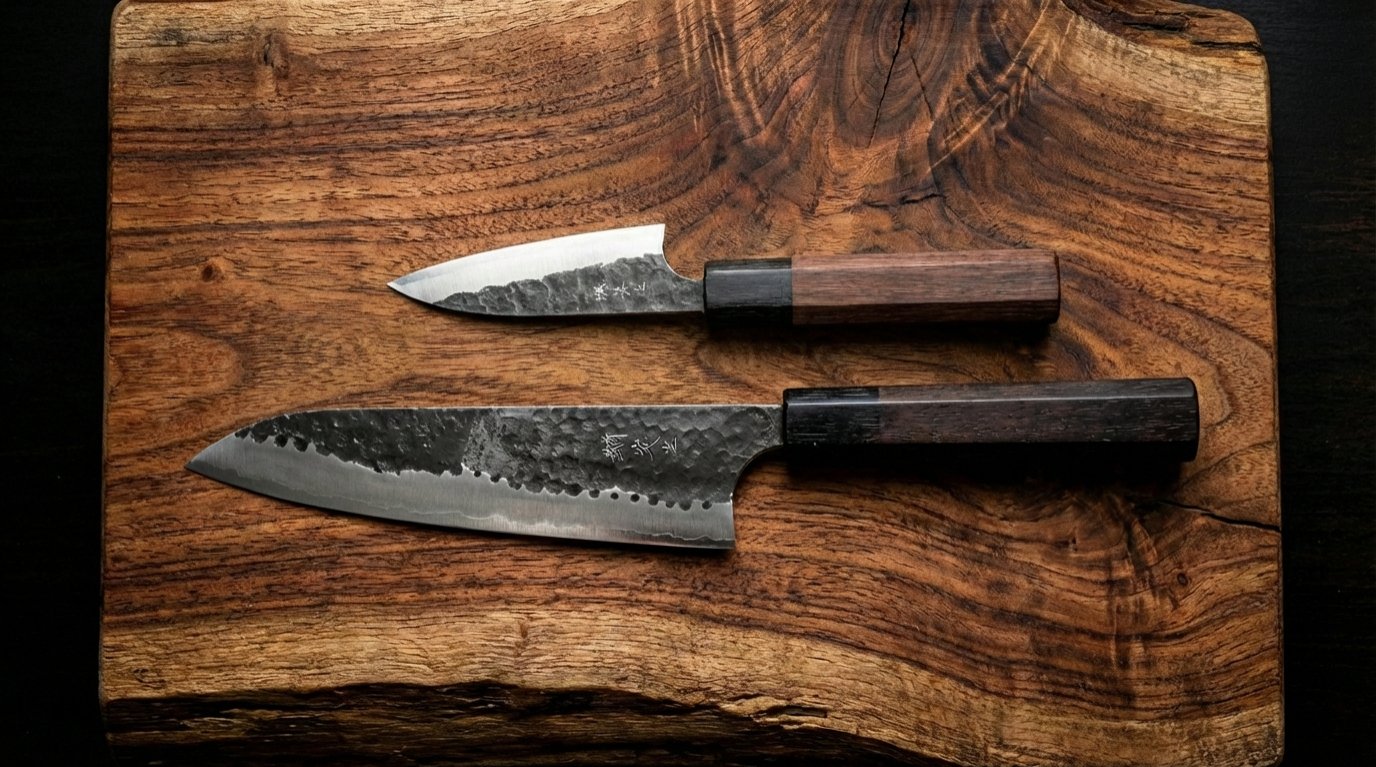
If you are a home chef, 95 percent of all work will be done by a perfect duo.
The first violin here is played by the main knife. This can be a Gyuto (牛刀)—the classic chef’s knife—or a Santoku (三徳). The latter’s name poetically translates to “Three Virtues,” symbolizing its ability to handle meat, fish, and vegetables. The Santoku is typically shorter, with a blunter nose and greater agility, making it a favorite in home kitchens.
The second member is the Petty. A small, versatile knife designed for tasks where its big brother would be too clumsy: peeling, trimming vegetables and fruit, or other meticulous in-hand work. Of course, it is always more enjoyable to have a matching duo. While function is paramount, aesthetic unity on a magnetic rack or cutting board adds an extra sense of joy and harmony to the daily routine.
Details That Change Everything
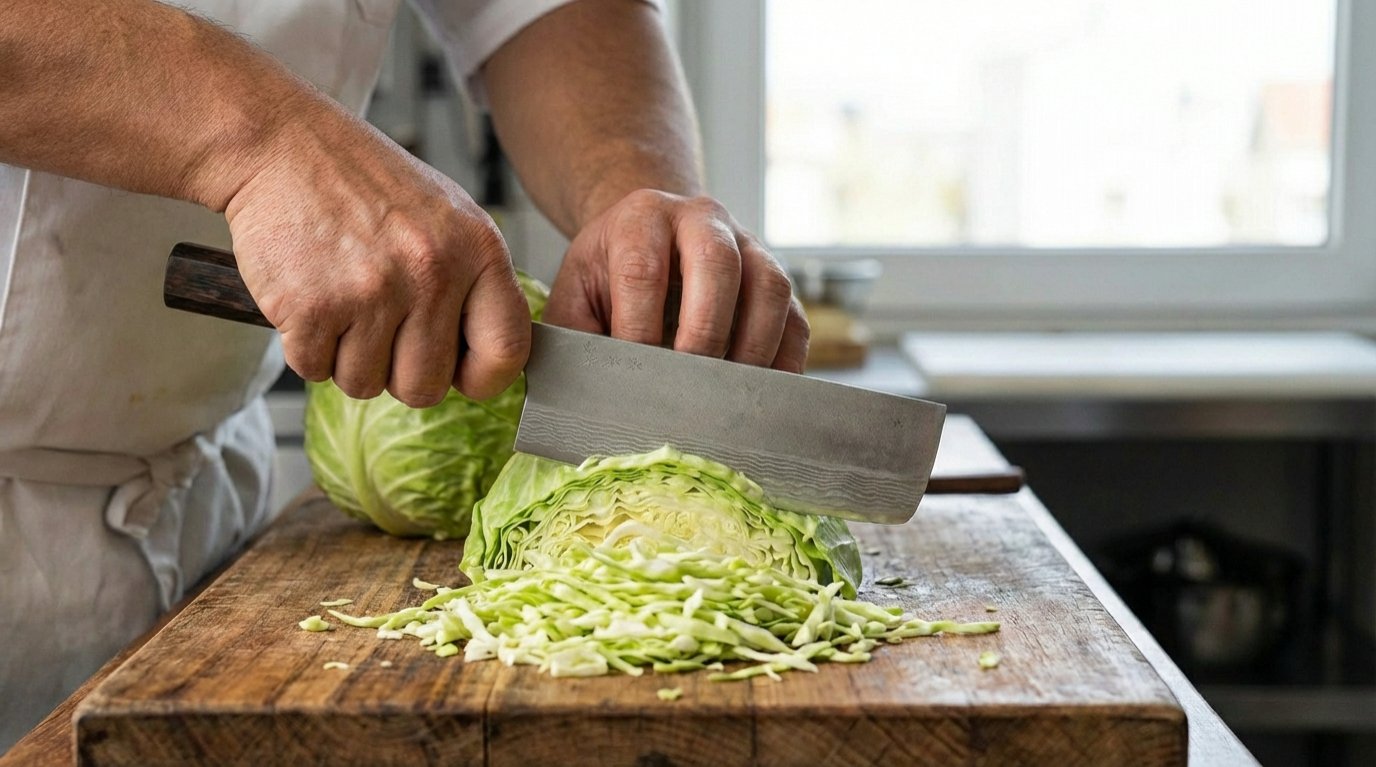 But if you have a specific passion, remember another proverb: “Mochi wa mochiya” (餅は餅屋)—”Leave the mochi to the mochi maker.” While a versatile knife can handle most tasks, a specialized tool will always outperform it in its own element.
For vegetarians whose day begins and ends with vegetables, the Nakiri (菜切)—a rectangular, cleaver-like knife—will bring joy with every cut. Its straight blade line allows for chopping through the full length without crushing the product. Meanwhile, for sushi masters or fish lovers, the Yanagiba (柳刃) is indispensable: it allows for slicing fish fillets in one long, gliding motion without damaging the texture.
The Technical Balance and the Golden Rule
You don’t need to be a metallurgist to grasp the essence. The key is to know that Japanese knives balance between 60–64 HRC (Hardness on the Rockwell scale). This is the “golden mean”: they cut fantastically and hold an edge for months, but in exchange, they demand respect. They cannot be twisted, nor used for chopping bone.
Here applies the simple but brilliant “Rule of Teeth” from Japanese masters: If you can’t bite through the product with your own teeth, don’t cut it with a Japanese knife. Frozen meat, bones, or hard lobster shells are taboo. A Japanese knife is a precision instrument, not an axe. For brutal tasks, always keep an old, thick “workhorse” in the drawer that you don’t mind abusing.
Also, pay attention to geometry. Most knives (Gyuto, Santoku) are double-beveled, making them suitable for both left and right-handed users. However, specialized knives like the Yanagiba are often single-bevel. If you are left-handed, be vigilant—a standard knife of this type will “drift” to the side in your hand.
Blade Finish—More Than Just Beauty
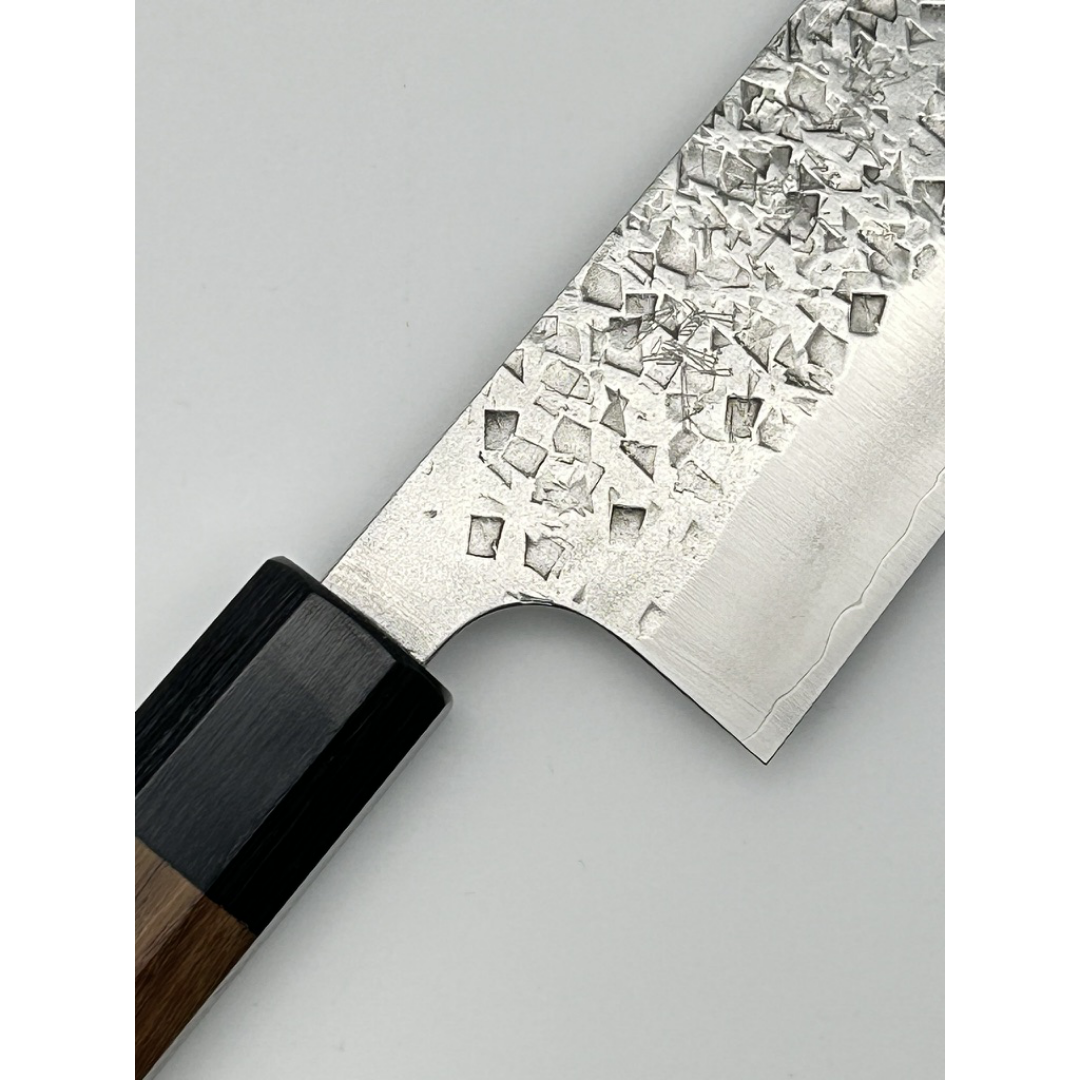 When you look at a Japanese knife, its surface tells a story. This isn’t just aesthetics—it is function.
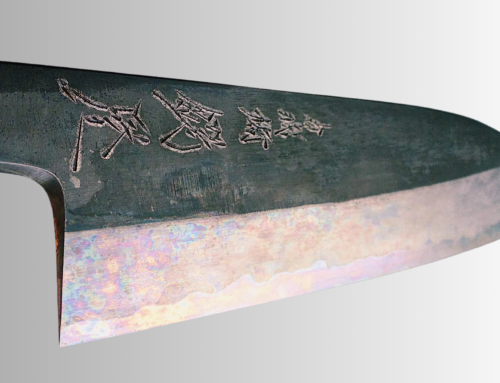
Perhaps you’ve seen knives with black, seemingly unfinished blades? That is Kurouchi (黒打)—the blacksmith’s finish. It looks rustic, but this authentic coating protects carbon steel from rust. Or maybe you’ve noticed a dimpled surface, as if struck by a hammer? That is Tsuchime (槌目). These irregularities create air pockets that prevent a wet potato or cucumber from sticking to the blade. There is also the elegant Nashiji (梨地)—a surface resembling the skin of an Asian pear, which hides fingerprints perfectly.
Investing in History
How much does a knife cost? That depends on how you count. A mass-produced knife will serve for a couple of years before it stops holding an edge and turns sharpening into your new hobby. But a handmade creation forged by masters like Yoshimi Kato, famous for his laser-thin grinds, or the genius of innovative design Yu Kurosaki, is an investment for decades. When you hold the legacy of Master Anryu in your hands, you aren’t paying for metal. You are paying for centuries of Echizen (越前) katana-making experience, distilled into one perfect edge.
The Ocean of Handle Choices
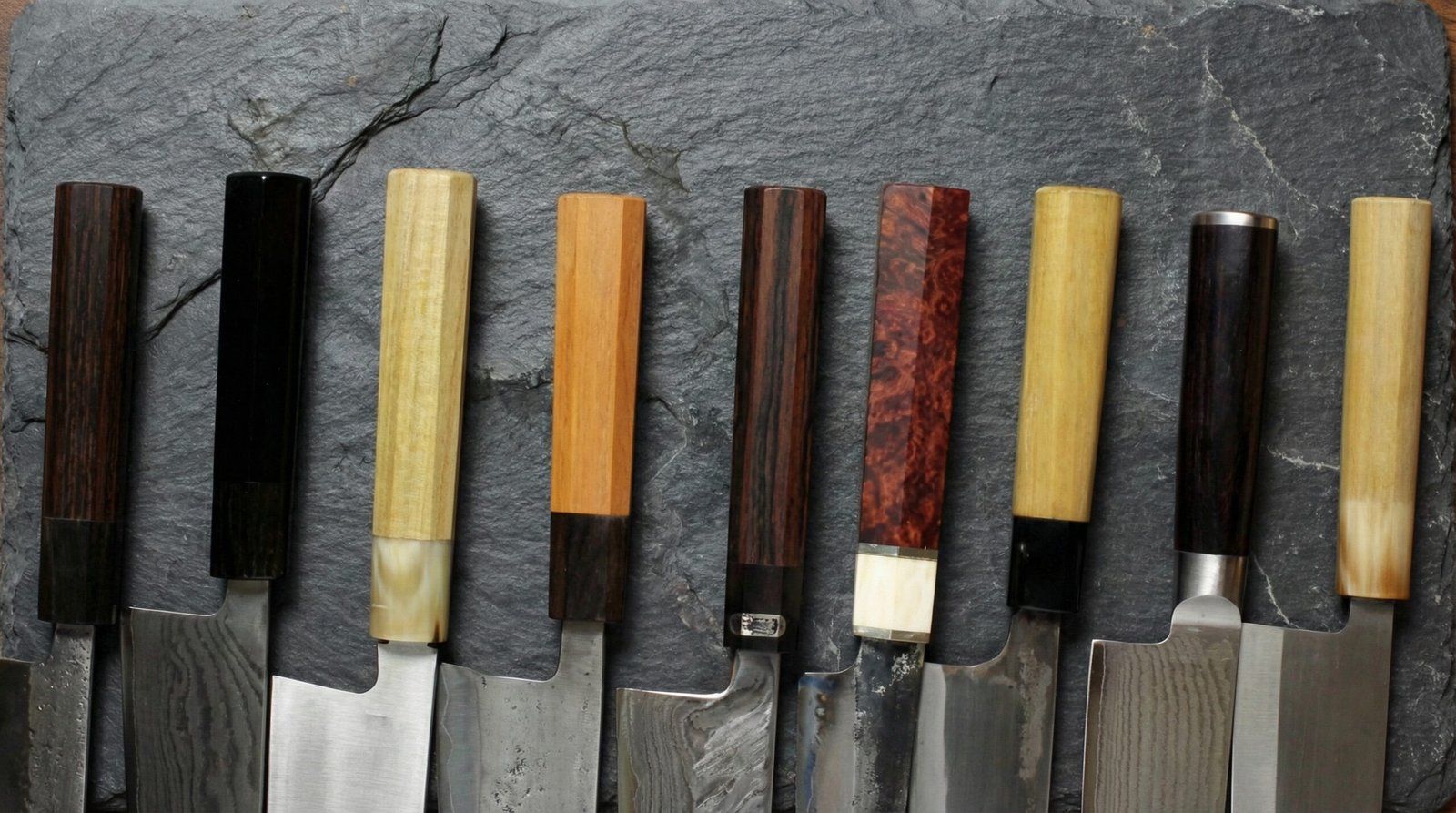 Finally, it all comes down to tactile sensation. Here opens a true ocean of choices, where the handle’s shape and material become the silent mediator between your thought and the cut.
The first direction is Wa handle, the traditional Japanese school, best described as a “dance of lightness.” These handles are designed to be almost weightless, shifting the balance entirely to the blade and allowing the knife to simply “fall” through the product. Octagonal geometry dominates here, and that is no accident. Its ridges act as navigation points for your fingers: even with your eyes closed, you intuitively feel the angle of the blade. For those seeking more softness, masters offer an oval shape that rests imperceptibly in the palm, or the traditional asymmetric D-shape, which perfectly fills the curve of the right hand.
Materials are no less important. The classic choice is Magnolia (Ho-no-ki)—a soft, light wood with the unique property of becoming grippier when wet. It offers a warm, authentic feel, often finished with a Pakkawood (resin-impregnated wood) ferrule—a living material that shrinks over time to hermetically seal the metal. For those seeking luxury, exotic woods like ebony or walnut are available, adding solidity to the knife while maintaining graceful Japanese aesthetics.
On the other side of the barricades stands Yo handle, the Western school, offering assured solidity. It is a fortress in your palm. These handles feature a full tang—metal extending the entire length—and are typically made from Pakkawood, an innovative composite of wood and resin. They are completely resistant to moisture and bacteria. Choose this option if you are accustomed to heavy German knives and enjoy feeling the tool’s weight and balance right in the center of your palm.
We understand that buying online can be daunting—after all, you can’t touch the item. That is why AcuteAngleShop.com adheres to a simple policy: Order it. Unbox it. Hold it. We offer a 10-day return guarantee. If the knife doesn’t “stick” to your hand, if the design in person isn’t what you imagined—simply return it (unused for food) and order another, or get a full refund.
Go ahead and try. Your perfect knife is already waiting to be discovered.